After years of low-value parcels entering the EU without import duties, a major change took place on July 1, 2026, and the brands who understand how it works are already in a better position than most.
This guide covers exactly what happened, how the new duty system works, what it costs, and what to do about it today.
What changed and why
The EU's duty-free exemption for parcels under €150 was a quiet structural advantage for cross-border ecommerce brands for years. It kept the cost of shipping into Europe low, simplified operations, and made competing in European markets significantly more accessible for brands shipping from China.
With the EU Council formally approving the implementation of new customs duties in February 2026, two years ahead of the originally planned 2028 timeline, that advantage is now gone.
The accelerated rollout reflects the scale of what the EU is dealing with: according to the European Commission, 4.6 billion small parcels entered the EU in 2024, with around 91% originating from China (EU Council, 2026). The changes aim to close the gap between cross-border imports and domestic retail, bringing international eCommerce in line with the standards EU-based retailers have always operated under.
How the new duty is calculated, and why your product mix matters
From July 1, 2026 onwards, every order you ship to Europe is subject to a €3 customs duty, applied per unique HS code in the shipment. An HS code is the international classification number assigned to every product type, and each distinct product category in an order carries its own code. So the more varied your order, the more you pay.
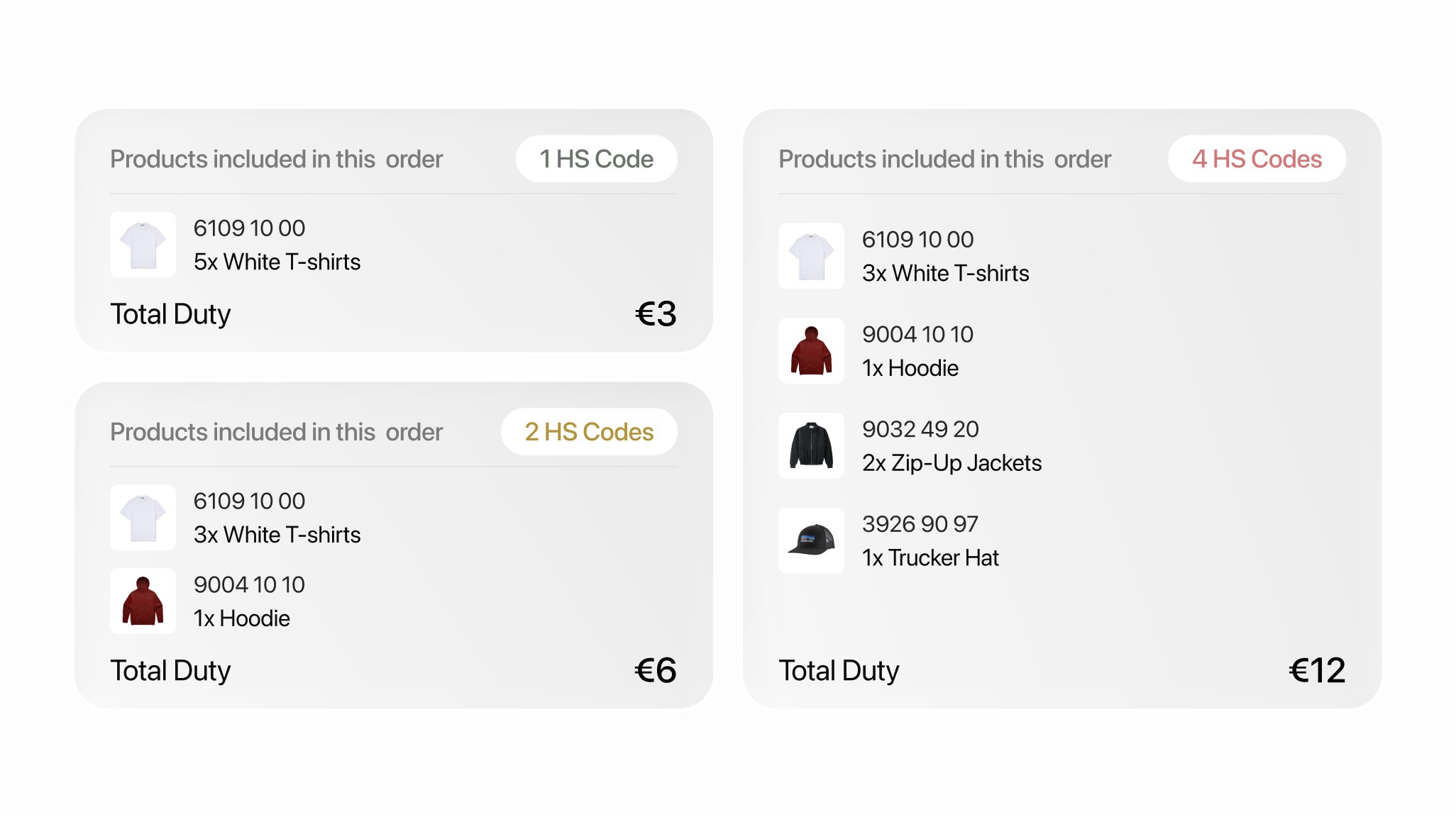
The practical implication:
- Five t-shirts in one order: they share the same HS code, so you pay €3 in duty total.
- Three t-shirts plus a hoodie: two different HS codes, so you pay €6 in duty.
- A t-shirt, a hoodie, a pair of joggers, and a cap: four different HS codes, so you pay €12 in duty.
The EU Council's own published example shows how quickly this adds up: a parcel containing one silk blouse and one wool blouse incurs €6 in customs duty, not because they are different products, but because different materials fall under different tariff sub-headings.
This is the part most brands don't know about. It's not just about mixing obviously different categories like shoes and bags. A single product type made from two different materials, like leather versus canvas, or silk versus wool, can generate two separate HS codes and therefore two separate duty charges. The broader and more varied your product mix, the more this adds up across your EU order volume. Getting a clear picture of your catalog's HS code structure is the most practical thing you can do to understand your actual cost exposure.
This is a transitional system. Here's what changes in 2028.
The flat rate €3 system is a bridge, not the destination. The interim measure runs from July 1, 2026 to July 1, 2028, by which time the EU's new Customs Data Hub is expected to be operational.
Once that centralized infrastructure is live, standard EU customs tariffs will apply to all goods entering the EU regardless of value. Duty rates will be determined by the specific product and its country of origin, and not a flat fee. Depending on how your products are classified, rates in 2028 could be meaningfully higher or lower than €3 per code (EU Taxation and Customs Union, 2026).
The practical implication worth noting now is that accurate HS code classification is very important. Getting your catalog properly classified today lets you understand what's coming and prepare for the regulation changes ahead.
What this means for your EU customers
This duty is entirely separate from VAT. Brands already collecting and remitting VAT will continue to do so as before. The new duties sit on top of existing obligations, not in place of them.
For your customers, what matters is how your shipments are structured. Under a Delivered Duty Paid (DDP) model, all duties are settled before delivery. Your customer receives their order cleanly, with no unexpected charges at the door and no delays at customs. Under a non-DDP model, customers are liable for duties on arrival, which means held parcels, surprise fees, and a delivery experience that falls apart at the last mile.
For DTC brands that have invested in building a strong end-to-end experience, an unexpected customs charge at delivery is the kind of friction that's entirely avoidable with the right logistics setup.
What to do now that the duty is live
Audit your HS codes.
Review every SKU in your product catalog and confirm its HS code classification. Identify how many distinct codes your typical EU order contains. This gives you a clear picture of what duties will be added to your EU orders.
Model the cost impact across your EU order mix.
Use your current EU order data to calculate the average duty cost per shipment under the €3 per HS code structure. If your margins cannot absorb this at current pricing, adjusting now gives you more options than adjusting after the costs have already built up.
Review your order structure.
Where possible, consolidating SKUs that share the same tariff classification reduces duty exposure. For high-volume sellers, it's worth considering whether bundling products into higher-value single orders changes the economics of EU fulfillment in a meaningful way.
Confirm your DDP position with your logistics partner.
If you are currently on a non-DDP arrangement for EU markets, confirm with your fulfillment partner how duties will be collected, declared, and paid on your behalf. If you're not on DDP, your customers will be the ones paying the duty at the door.
Start thinking about 2028.
The 2026 flat rate is the simplified version of what's coming. Standard product-specific tariffs from 2028 will be based on full HS classification and country of origin. Getting your catalog accurately classified now gives you enough time to get everything set up properly before 2028.
How ecomflow handles this for your brand
ecomflow provides a Delivered Duty Paid service for all EU shipments, which means we advance customs duties and manage customs clearance entirely on your behalf, so your customers receive their orders without any unexpected charges at the door. A smooth delivery keeps customers coming back, and it's the same standard we apply across all 100+ markets we ship to, not just to Europe.
On the compliance side, our internal system automatically assigns HS codes to each SKU the moment a shipment to an applicable European country is triggered, so you don't need to look this up manually or slow down your fulfillment while you figure it out. ecomflow makes sure those codes are structured correctly within each declaration so your shipments are fully compliant and you're only paying what you're required to.
We also work with brands to clean up their product data, clarify how bundles should be declared, and keep clients updated as new guidance from customs authorities comes through. It's the same hands on approach that's helped over 300 DTC brands scale with us, having a partner who's already built for changes like this.
The goal throughout is straightforward: full compliance and the correct duty cost for your products, handled by us so you don't have to worry about it. If you have questions about how these changes affect your specific product range or fulfillment setup, get in touch with our team.
This article is for informational purposes and reflects the regulatory position as of July 2026. We recommend consulting your logistics partner and a customs specialist for guidance specific to your business.
Sources: EU Council press release, 11 February 2026 (https://www.consilium.europa.eu/en/press/press-releases/2026/02/11/council-gives-final-green-light-to-new-customs-duty-rules-for-small-parcels/) · European Commission customs reform overview (https://www.consilium.europa.eu/en/policies/modernising-the-eu-customs-union/)